Where New Jersey Cities Get Their Drinking Water
New Jersey cities do not all draw drinking water from the same kind of source. Your tap may be supplied by river water, a reservoir, groundwater, or water provided by another system. Knowing the source helps you find the right report, understand local notices, and distinguish a supply-wide issue from a concern inside your own plumbing.
Start with the supplier, not the city name
A city’s name does not always tell you where its drinking water comes from. Municipal boundaries and water-service boundaries can differ: a city may have more than one supplier, or a supplier may serve customers across multiple communities. In some places, one system may also buy water from another. The practical first step is to identify the supplier responsible for your address.
A water bill is often a useful starting point. Look for the water provider’s name, but check carefully if the bill comes from a municipality, landlord, or property manager rather than directly from the water system. The name on the bill may identify the billing office without making the supplier relationship obvious. If you rent, ask the landlord or property manager which water system serves the building, and compare the answer with the information on the bill or a recent notice.
You can then use the supplier’s name to find its water quality report. These reports describe the supply system and its results, but they may not resolve every question about a particular faucet. Results for the system as a whole are not necessarily the same as a test of water from one home’s tap. For that distinction, see Annual Reports vs. Your Faucet: Why System Results Aren’t Your Tap.
New Jersey has tools that can help connect a town or address to a supplier and its reports. Looking Up Any Supplier by Town in NJDEP’s Drinking Water Viewer explains how the state’s Drinking Water Viewer can help identify systems. For another route to reports, see How to Find Water Reports With the Jersey WaterCheck System Finder. These tools can be especially useful if a town has more than one supplier or if your provider’s name is unfamiliar.
Once you know the system, look for the current water quality report and check that it covers your supplier and community. A report for a neighboring system may look relevant but describe a different supply. Finding the Water Quality Report for Your New Jersey Address offers a practical way to track down the report that applies to your location.
Why a city can have more than one answer
The question “Where does this city get its water?” can have several answers, depending on the neighborhood, building, or system serving a property. A city may receive water from a regional supplier, while another part of the municipality is served by a separate system. A supplier may also use more than one source, either routinely or as an alternate. And a system that delivers water to homes may purchase some or all of it from another utility.
That is why a map of municipal boundaries is not enough to identify your source. The supplier’s report is a better place to confirm which sources are associated with the system. If the report describes multiple sources, check whether it identifies a primary source, alternate sources, or a blend. Those terms matter: an alternate source listed in a report is not automatically the source currently supplying your tap.
The article One Town, Two Suppliers: How New Jersey Municipalities Split Service covers why people in the same town can have different suppliers. If the system name on a notice differs from the name on your bill, Who Supplies Your Water? New Jersey’s Regional Suppliers, Explained can help clarify the relationship between suppliers and customers.
Rivers and reservoirs: surface-water supplies
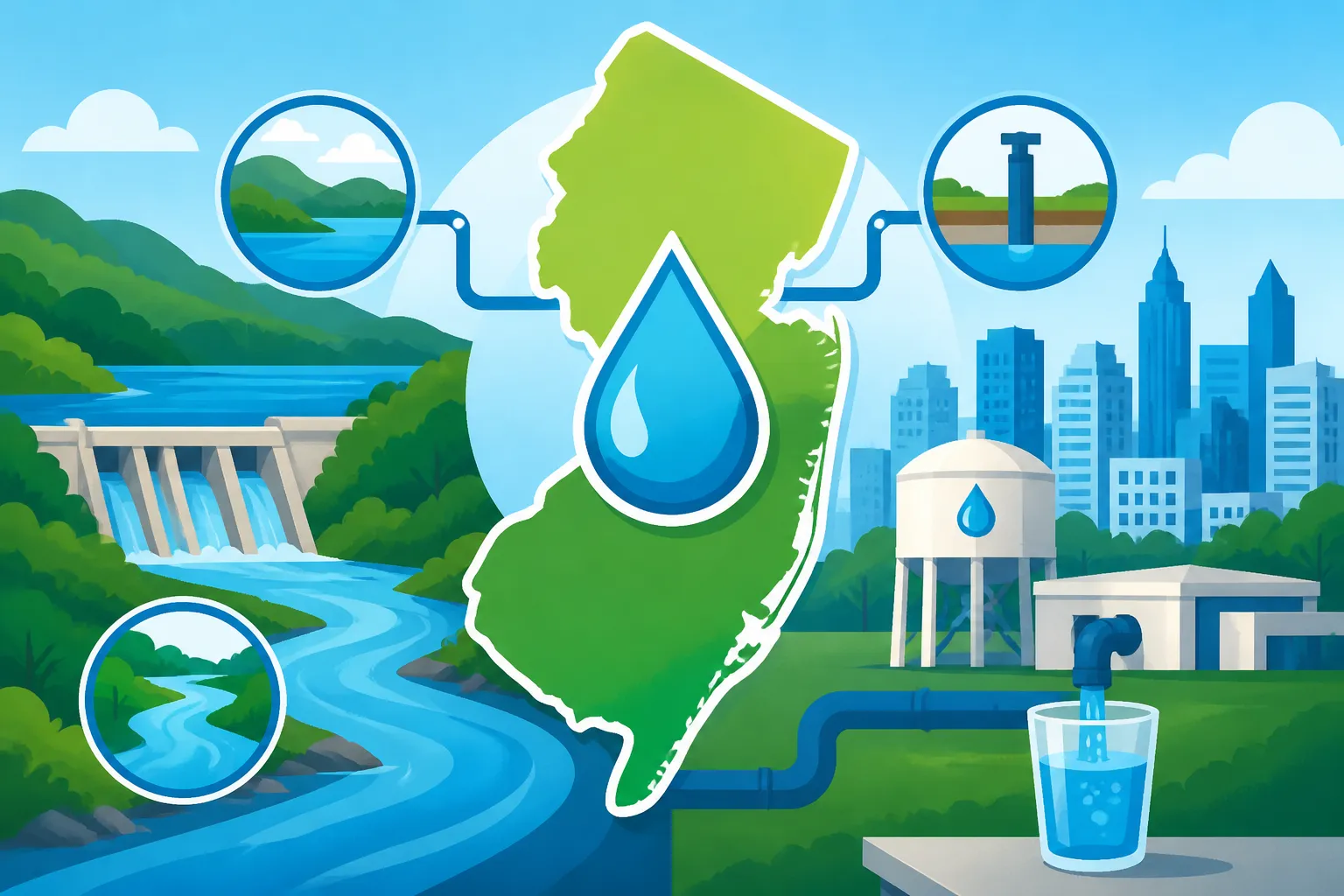
Surface water is water collected from sources such as rivers and reservoirs. A utility may draw from one source or rely on several sources. Surface water can vary with conditions in its watershed, so a supplier’s report is useful for understanding which sources the system identifies and whether it describes alternatives.
For a clear New Jersey example, in the 2026 report, Passaic Valley Water Commission identified the Passaic River in Totowa, New Jersey, as its primary water source and the Pompton River and Point View Reservoir as alternate sources. This shows why a report may name more than one source without implying that all are being used at the same time. The supplier’s own report is the place to confirm how it describes its sources.
The source alone does not tell you everything about the water that reaches a customer. Water drawn from a river or reservoir is treated before it enters the distribution system. The report may describe the treatment process and water-quality results, but those details should be read as information about the system, not as a guarantee about every faucet in every building.
Surface-water systems also have to pay attention to conditions in the source area. According to New Jersey Department of Environmental Protection, water systems using surface water supplies tend to be the most vulnerable to harmful algal blooms. That does not mean every surface-water source has an active bloom, or that a bloom automatically means a tap-water problem. It does mean source-water conditions are one reason utilities monitor their supplies and issue notices when needed.
If a notice mentions an algal bloom, read the instructions from the responsible utility or agency rather than trying to infer household safety from the source name alone. Harmful Algal Blooms and New Jersey Drinking Water Sources explains how source conditions relate to drinking-water supplies. For urgent notices, How New Jersey Utilities and NJDEP Announce Urgent Water Advisories can help you understand where to look for current information.
What source-water information can tell you
A source-water section in a report can help you answer practical questions:
- Does the supplier identify a river, reservoir, or another kind of source?
- Does the system list a primary source and alternate sources?
- Does the report describe a single source or more than one?
- Does the report explain whether the system buys water from another supplier?
- Does it point to additional source-water information?
Those answers help you understand the system, but they are not a substitute for checking current notices. A report is a periodic summary. A utility notice addresses a specific event or operational condition. If the two appear to say different things, check the supplier’s current communications and ask the utility to clarify which information applies to your address.
The source’s location may also be different from the place where water is treated or delivered. A river intake, reservoir, treatment facility, and customer’s home are separate points in the supply chain. Knowing the source is useful, but it does not by itself explain every treatment step or the route water takes before reaching a tap.
Groundwater: wells and aquifers
Groundwater is held beneath the land in geological formations called aquifers. A utility can draw it through wells and then treat or manage it before supplying customers. The report may identify wells, an aquifer, or both. Those terms describe where raw water comes from; they do not mean that customers receive untreated water directly from a well.
Camden offers a documented example. In the 2025 report, City of Camden Division of Utilities stated that its water system consisted of 18 wells drawing raw water from the Lower Potomac-Raritan-Magothy Aquifer. This is a specific description of that system, not a template for every New Jersey city. Other systems may use different aquifers, surface water, purchased water, or a combination of sources. Check the report for the system that actually serves your property.
A report that names an aquifer can help you understand the general source of the supply, but it should not be used to guess the water quality at an individual home. A system’s reported results and a household’s tap result answer different questions. Home plumbing, service lines, and building conditions can affect water after it has left the supplier’s system. For more context, see Surface Water or Groundwater? How the Source Shapes NJ Tap Results.
Groundwater and surface water also call for different source-area questions. A groundwater system’s report may identify wells or an aquifer; a surface-water system may identify a river or reservoir. These labels can guide what to look for in the report, but they do not tell you which contaminants to test for in a private well or which home treatment to buy. A public supplier’s report is not the same as a private-well test result.
Public water and private wells are different situations
This article focuses on water supplied through public systems. If your property has a private well, there may not be a city supplier or a system-wide report that describes your own tap. The well owner is responsible for understanding the well’s results and any treatment equipment serving the property. A nearby public water report cannot stand in for a test of a private well.
If you are unsure whether a home is connected to public water or uses a private well, check the property records, ask the owner or landlord, and look for the provider named on the water bill. Renters can also ask who is responsible for the supply and request the relevant test information. Private Well or Public Water? How New Jersey Renters Can Tell discusses how to sort out that basic question.
If you do have a private well, start with testing information that applies to private wells rather than relying on a nearby city’s report. Owning a Private Well in New Jersey: Upkeep, Equipment and Treatment explains the different responsibilities that come with a private supply.
From raw source to the water at your tap
The source describes where a water system obtains raw water. It does not, by itself, describe the full path from that source to a household faucet. For public water, the system treats and distributes water through infrastructure before it reaches customers. The supplier’s report is the best place to look for its description of source water, treatment, and reported results.
This distinction can prevent a common misunderstanding: a natural source name is not a complete description of the water you drink. Water from a river, reservoir, or aquifer is not automatically the same as water delivered to a home. Treatment and system operations are part of the picture. So are the pipes and fixtures between the supplier’s system and the faucet.
A Consumer Confidence Report can help you understand the supplier’s reported water-quality information. To read one efficiently, first confirm the supplier and the report period. Then review the source-water description, treatment information, detected substances, and any notices or explanations included by the system. Reading a New Jersey Consumer Confidence Report, Section by Section explains how to interpret the report’s parts without treating it as a test of your own household plumbing.
What a system report can and cannot answer
A supplier’s report is useful for understanding information reported for the public water system. It can tell you which sources the supplier identifies and what the report says about system-level water quality. It may also explain treatment and provide context for results.
A system report does not necessarily tell you:
- Whether your home has a particular service-line material.
- Whether an older building’s plumbing affects the water at a faucet.
- Whether a filter in the home is working as intended.
- Whether water from a specific tap would produce the same result as system sampling.
- Whether a notice issued after the report was prepared is still in effect.
Those questions may require a separate step. For example, a service-line concern calls for checking the line information available from the supplier and understanding the building’s plumbing. A new taste, odor, or color may call for contacting the utility and checking whether neighbors are noticing the same change. A suspected water-quality issue at one faucet may require a suitable sample or other follow-up rather than relying only on the annual report.
The article Reading a New Jersey Consumer Confidence Report, Section by Section is useful when a report includes technical terms or results that are hard to interpret. For questions about a particular tap, On Town Water in New Jersey? When Testing Your Own Tap Makes Sense explains when household testing may provide information that a system-wide report cannot.
How to identify the source for your address
You can usually narrow down the answer by working from your own address toward the source, rather than starting with a general map of New Jersey. The sequence below helps avoid mixing up a city, a supplier, and a water source.
- Check a recent water bill. Note the name of the provider and whether the bill appears to come from the water supplier, the municipality, or another party.
- Confirm the system serving the property. Use a supplier lookup or ask the utility to verify the service area for your address. If you rent, ask the landlord or property manager as well.
- Find the matching water quality report. Confirm that the report is for the supplier identified for your property, not simply a nearby city or a familiar provider.
- Read the source-water description. Look for named rivers, reservoirs, wells, aquifers, purchased water, and any listed alternate sources.
- Check for current notices separately. The report may not include a newer operational notice. Check the utility’s current announcements when you need up-to-date instructions.
- Ask the supplier about anything unclear. A utility can clarify which system serves you, whether listed sources are primary or alternate, and where to find the current report or notice.
If you cannot identify the supplier from the bill, look at recent mail or electronic notices from the water provider. A building manager may have the account information if water service is billed through a landlord or property management company. When asking for help, provide the service address rather than relying only on the city name. An address makes it easier to distinguish between nearby systems that serve different parts of the same municipality.
Once you have the report, read the source description with care. A system may list more than one source. It may also describe water purchased from another utility. Do not assume that every source in a list contributes equally, or that an alternate source is active whenever you read the report. If the report does not say how the sources are used, ask the supplier.
For help finding and comparing source information, see Where to Find Source Water Information in a New Jersey CCR. If you want to understand the difference between a supplier and a municipality, Who Supplies Your Water? New Jersey’s Regional Suppliers, Explained is a useful next step.
A quick comparison of source types
| Source or arrangement | What it generally means | What to check in the report |
|---|---|---|
| River | The system draws raw water from a flowing surface-water source. | The river name, whether the source is primary or alternate, and the system’s treatment information. |
| Reservoir | The system identifies stored surface water as a source. | The reservoir name and whether the report describes it as a primary or alternate source. |
| Wells and aquifer | The system draws groundwater through wells from an underground formation. | Well or aquifer information and the report’s description of treatment and results. |
| Water purchased from another system | The supplier may deliver water obtained or treated by a separate system. | Which supplier provides the water and which report or notice covers the delivered supply. |
| Multiple or alternate sources | The system identifies more than one potential source. | How the report distinguishes active, primary, alternate, or blended sources. |
This table is a starting point, not a substitute for the report. Terminology varies, and the supplier’s description is what matters for its system. If the report does not make clear how a source is being used, ask the supplier rather than inferring the answer from the list.
When the source or supplier changes
Water systems may use multiple sources or change which sources they rely on. A report may identify alternate sources, while current supplier information may explain how the system is operating. A change in source can make customers wonder whether their water has changed, but the source name alone does not tell you what the water’s measured results are or whether a special action is needed.
A source change and a water-quality advisory are also different things. A system may adjust its supply without issuing a boil-water notice. Conversely, a notice may be issued because of a specific event unrelated to a long-term source change. Follow the current instructions from the supplier or responsible agency rather than assuming a change in source automatically means a household should take a particular action.
If your tap’s taste, odor, or appearance changes, consider whether the supplier has issued a notice and whether the change is limited to your home. A change noticed across a neighborhood may point toward a system or distribution issue, while a change limited to one fixture can have a different explanation. Neither observation proves the cause, so contact the utility when the change is new, persistent, or accompanied by a notice. Taste, Odor and Color in New Jersey Tap Water: A Troubleshooting Guide describes practical ways to approach these changes.
If a supplier buys water from another system, finding the source may require looking beyond the name printed on your bill. The customer-facing supplier and the system that produces or treats the water may not be the same organization. A report may explain the relationship, or the supplier may be able to direct you to the relevant information. When One New Jersey Supplier Buys Water From Another covers this distinction.
When an advisory is involved, use the supplier’s current notice to check what area it covers and what actions it asks customers to take. Do not rely on a report from an earlier period to decide whether an advisory still applies. For help checking coverage, see Does a New Jersey Boil-Water Notice Cover Your Street? How to Check. When the notice ends, follow the utility’s instructions for what to do next; How Will You Know When a New Jersey Boil-Water Advisory Is Over? explains how to look for that update.
Frequently Asked Questions
Do all homes in one New Jersey city get water from the same source?
Not necessarily. A municipality may have more than one supplier, and a supplier may use more than one source or purchase water from another system. Confirm the provider for your address and check that system’s report.
Does a river or reservoir listed in a report mean that water goes directly to my faucet?
No. The source describes where raw water comes from. A public system treats and distributes water before it reaches customers. The report can provide more information about the supplier’s process and results.
If a report lists an alternate source, does that mean the system is using it now?
Not necessarily. A listed alternate source is not automatically the source currently supplying your tap. Check the report’s wording and ask the supplier if it does not explain how that source is used.
Can a city water report tell me what is happening at one faucet?
A system report is not the same as a test of a particular household tap. Plumbing and service-line conditions can affect water after it leaves the public system. If your concern is specific to your home, ask the supplier what information is available and consider whether an appropriate tap test is needed.
What should I do if I cannot tell which system serves my address?
Check your water bill and recent notices, then contact the listed provider and ask it to confirm the service address. If you rent, ask the landlord or property manager as well. A supplier lookup tool may help when a town has more than one system.
Sources
- Passaic Valley Water Commission — 2026CCR 2025WQR Pvwc (PDF) (checked November 13, 2026)
- City of Camden Division of Utilities — PWSIDNJ0408001 2026 Annual WQ Report CCR 2025 Data (PDF) (checked November 13, 2026)
- New Jersey Department of Environmental Protection (checked January 18, 2026)
Disclaimer
This article is for general informational purposes only and does not constitute professional advice. Laws, prices and regulations vary by location and change over time. Consult a qualified professional for guidance on your specific situation. New Jersey Water Guide is not a government agency or water utility and is not affiliated with any public water system.