Is New Jersey Tap Water Safe? How to Check Your Own Supply
A simple yes-or-no answer about New Jersey tap water can’t tell you whether your own faucet is covered by a current notice, what your supplier’s latest results show, or whether home plumbing could affect the water. The practical answer comes from checking the right supply, reading its report carefully, and following up on anything that applies to your address.
What “safe tap water” means in New Jersey
New Jersey has some of the strictest standards for public drinking water anywhere, according to the New Jersey Department of Health. That is an important reason not to assume public tap water is unsafe simply because a contaminant appears in a report or a neighbor has a concern. But a statewide standard does not, by itself, establish what comes out of every faucet at every moment.
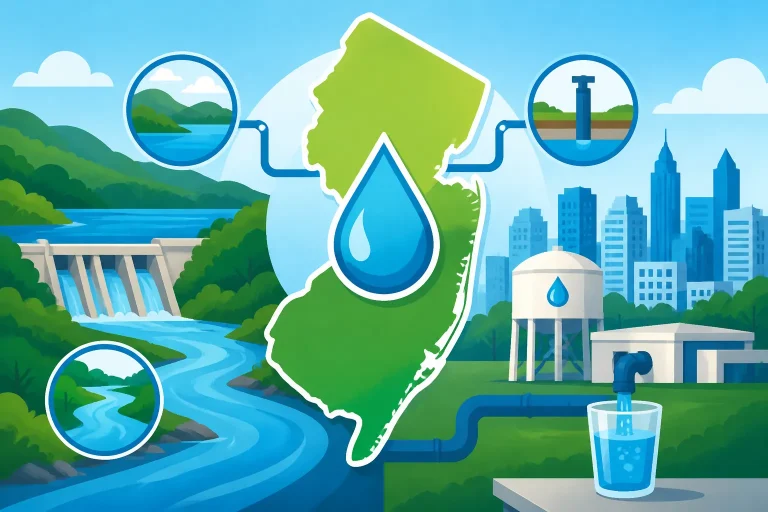
The answer depends on several layers: the public water system that treats and delivers water, the quality results reported for that system, any current advisory or notice, and the plumbing between the water main and your tap. A home served by a private well has a different checking process from a home connected to a public system. So the first question is not just whether New Jersey tap water is safe. It is: which supply serves your address, and what information applies to that supply and home?
Public systems are subject to testing and drinking water requirements. The New Jersey Department of Environmental Protection says public community and non-community water systems must test their water on a rigid schedule and at specific locations. The Division of Water Supply and Geoscience protects public health and safety by ensuring public community water systems serve water that meets all Federal and State Drinking Water Standards.
Those requirements provide a structured way to monitor public water, but they do not mean every customer’s kitchen tap is tested each time water is used. Many results describe samples collected at designated points in a water system, not a sample taken from your faucet. That distinction matters when a home has old plumbing, a lead service line, a treatment device, or a water-quality change that appears only at one fixture.
A useful way to assess your situation is to separate the questions:
- Who supplies the water? A town name alone may not identify the system that serves your specific address.
- What do the supplier’s results show? A water quality report summarizes system results and required information, but it is not necessarily a test of your home’s tap.
- Is there a current notice? An advisory or other urgent notice can change what you should do temporarily.
- Could the home’s plumbing affect the water? Issues inside a building or in a service line may not be explained by a system-wide report.
- Is your household on a private well? A public-system report does not describe water from a private well.
For a first overview, see Is New Jersey Tap Water Safe? How to Check Your Own Supply is the title of this article, so don’t link. Instead internal link to Finding the Water Quality Report for Your New Jersey Address and Not Sure Which NJ Water System Serves You? Start With Your Bill. A result is reassuring only when you know which system it covers and what it does not cover.
It is also useful to distinguish a water-quality concern from a health question. An unusual taste or color may have several possible explanations, and appearance alone cannot confirm what is present. If you are concerned about a possible health effect, ask your local health department or a medical professional. For water-system questions, contact the supplier using current contact details on its official website.
Find the water supply that actually serves your address
Before interpreting a report or buying a filter, identify the source of the water at your tap. Residents sometimes assume their municipality is their water supplier. But a municipality may receive water from a neighboring supplier, rely on more than one system, or have service boundaries that do not match its town boundaries. A town name is a useful starting point, not always a complete answer.
Begin with a recent water bill, if the account is in your name. Look for the name of the water provider or the entity that bills for water service. A landlord’s bill, a combined utility bill, or a lease may provide clues, but do not assume the company handling payment is the same entity that operates the water system. If you rent, ask the landlord or property manager which supplier serves the building and where tenants can find its water-quality information. The article Renters and Tap Water in New Jersey: Bills, Lead Notices and Reports covers questions renters can raise.
If a bill does not settle the question, use the supplier’s official website or a state tool to check the address or town. NJDEP’s Drinking Water Viewer and the Jersey WaterCheck system finder can help people look for public-supply information. The two tools answer different questions, so use the one that fits the detail you need. Jersey WaterCheck vs. Drinking Water Viewer: Which Tool Answers What explains how to choose between them, while Looking Up Any Supplier by Town in NJDEP’s Drinking Water Viewer focuses on finding a supplier by location.
When searching, check the full address where possible rather than relying only on a town-level result. If the result names a supplier but the boundary or building coverage is unclear, confirm it with the supplier directly. An apartment building may be served by the same public system as nearby homes, but the property’s internal plumbing and service-line details can still differ.
Next, decide whether the property is connected to a public water system or uses a private well. Ask the property owner, review utility records or bills, and check the water equipment and plumbing if necessary. A well pump, pressure tank, or wellhead may indicate private-well service, but an unfamiliar setup should not be identified by appearance alone. A property might also have an old well that is no longer used, so verify the active supply rather than making assumptions based on a visible pipe or pump house.
If you are on public water, the supplier’s report is your starting point for system-level results. If you are on a private well, a nearby public-system report does not tell you what is in that well. Private-well owners need water testing suited to the well and the reason for testing. The articles Owning a Private Well in New Jersey: Upkeep, Equipment and Treatment and Where to Get Your Water Tested in New Jersey can help you follow the separate path.
| What you have | Where to start | What the information can tell you | What it may not tell you |
|---|---|---|---|
| Public water and a recent bill | Identify the supplier named on the bill, then verify the address if needed | Which public system may cover the property | Whether a particular faucet or home plumbing has been tested |
| Public water but no clear bill | Check the supplier’s official website or NJDEP’s Drinking Water Viewer | A likely supplier and available system information | Whether service boundaries include the exact property |
| Rental with water included | Ask the landlord or property manager for the supplier and report | Which report applies to the building’s supply | The condition of every fixture or internal pipe |
| Private well | Confirm that the well is the active source and arrange appropriate testing | Results for the sampled well water | The condition of a different well or the plumbing beyond the sample point |
| A system with a current notice | Check the supplier’s official notice and confirm whether the address is covered | The instructions that apply during the notice | Whether a notice has ended unless the supplier confirms it |
Keep a note of the supplier’s name and the exact address or building covered by the information you find. That small step helps prevent a common mistake: reading the right kind of report for the wrong water system.
Read the water quality report without overreading it
A public water supplier’s consumer confidence report, also called a water quality report, is a practical source of information about system results. It can help you understand what the supplier monitors and whether the report describes any issues that require attention. The report is not a pass-or-fail grade for every faucet in every home, and it should be read with its scope in mind.
Start by confirming that the report names the supplier you identified for your address. Then check the service area described in the report. If the report covers several communities, look for a section explaining which results or sources apply to which area. Some systems use multiple sources or purchase water from another supplier. If the report’s coverage is unclear, ask the supplier to explain which section applies to your home.
Look at the report’s summary before focusing on a single table entry. A report may include information about monitoring, detected substances, standards, and any required explanation of a problem. The exact layout varies. If you find a value or term you do not understand, use the report’s own definitions and explanatory notes rather than guessing from the name alone.
A detection does not automatically mean a health emergency. Reports may list a substance because it was measured, even where the result is below the applicable limit. Conversely, a general statement that a system meets requirements does not tell you whether your home has a plumbing issue. Keep the two questions separate: what the system’s samples show, and whether the water at your own faucet has been affected after it reaches the property.
Pay attention to the sample location and what the result represents. Public systems collect samples according to required schedules and at designated locations. A system result is meaningful for monitoring the system, but it should not be treated as a direct measurement from your kitchen tap unless the report says the sample was taken there. For lead concerns, for example, a home’s service line and fixtures may matter. A customer should not use a general system result as proof that every tap has the same result.
Also distinguish a health-based standard or limit from an action level or monitoring measure when the report uses those terms. They are not interchangeable, and one table entry does not necessarily tell you what to do in your home. MCLs vs. Action Levels on a New Jersey Water Quality Report explains the difference, and Reading a New Jersey Consumer Confidence Report, Section by Section offers a more detailed way to work through the report.
If the report refers to a violation, missed monitoring, or corrective action, read the explanation rather than stopping at the label. Find out what part of the system was involved, what time period the report covers, whether the issue is ongoing, and what the supplier says customers should do. If the explanation does not answer those questions, contact the supplier through its official website and ask for clarification. A general report should not be used to invent a household instruction that the supplier has not given.
Reports also have a time frame. They describe data collected for a reporting period, not necessarily a real-time reading at your faucet. A report can be the best starting point for understanding routine monitoring while a separate current notice addresses a more immediate event. Check both when there is an active concern.
For a focused lookup, see How to Find Water Reports With the Jersey WaterCheck System Finder. If you already have a report but are unsure what a result means, Making Sense of Water Test Results in New Jersey can help with the language and units used on test results. If you are comparing a report with a recent change at home, keep the supplier’s findings separate from your own observations until you know whether the two are connected.
Check for current advisories and changes in water quality
A report is not a substitute for checking current notices. A water main break, pressure problem, treatment issue, or other event may lead a supplier to issue instructions for affected customers. Those instructions are specific to the event and may apply only to part of a service area. Do not assume a notice covers your home because it mentions a nearby town, and do not assume it excludes you because your street name is missing from a general headline.
When you hear about a possible advisory, start with the supplier’s official website and current notices. Check the affected streets, service area, and the instructions customers are asked to follow. If the notice is unclear, contact the supplier using current details listed on its official website. For urgent health questions, contact the local health department or a medical professional.
A boil-water advisory is a temporary instruction that should be followed as written. Do not replace the supplier’s instructions with guesses about whether a filter, refrigerator dispenser, or water treatment device makes the water suitable to use. The article What to Do During a Boil-Water Advisory in New Jersey explains how to approach an advisory, and Does a New Jersey Boil-Water Notice Cover Your Street? How to Check focuses on verifying the affected area. When the supplier announces that an advisory has ended, follow any post-advisory directions it provides.
Notice how the supplier distinguishes a general water-quality report from an urgent notice. A report describes monitoring over a reporting period. An urgent notice is meant to communicate a current event and what affected customers should do. One does not cancel out the other. A favorable result in an older report is not a reason to ignore a current instruction.
Pay attention to changes at your own taps, too. A new taste, odor, color, or cloudiness may be related to plumbing, a building’s water system, work in the area, or another cause. The appearance or smell alone does not identify the cause or establish whether the water is safe to drink. If the change is sudden, widespread in your home, or coincides with a utility notice or nearby work, contact the supplier and describe what you are seeing. If the issue seems limited to one fixture, a plumber may help assess the home’s plumbing.
For help sorting out a change in appearance or taste, see Taste, Odor and Color in New Jersey Tap Water: A Troubleshooting Guide and When to Call a New Jersey Utility About a New Taste, Odor or Color. If the water is discolored after nearby work, Brown, Yellow or Cloudy Tap Water After Nearby Work in New Jersey offers a focused set of checks. Avoid treating an unusual appearance as proof of either danger or safety.
Households that do not receive utility communications directly may need another way to stay informed. Renters can ask the landlord how notices are shared and which supplier serves the building. If a tenant may miss messages sent to the account holder, How Can New Jersey Renters Get Boil-Water Alerts They Would Miss? addresses how to ask about alerts and notices.
Consider what can happen between the water main and your faucet
A public water report describes results for a water system. Your home’s water has another part of the journey: the service line, building plumbing, fixtures, and any treatment equipment. Those parts can affect what comes out of an individual tap, even when a system-level report does not identify a problem.
Lead is a useful example of why the distinction matters. Lead can enter water from plumbing materials after water leaves the public system. A report for the supplier is therefore not a direct substitute for checking your service line, old plumbing, or faucet. A notice about a service line may describe its known or uncertain material, but the notice should be checked against the property and the supplier’s records. Lead Service Lines in New Jersey: Inventories and Replacement explains why service-line information matters, while How to Identify Your Home’s Water Service Line Material in New Jersey describes how to investigate the line at a home.
If you rent, the service line may be outside your control, but that does not mean you should ignore the information. Ask the landlord or property manager whether the building has received a service-line notice, what the supplier’s records show, and whether a tap test has been done. The supplier may also have an address lookup or customer process for service-line questions. Renters and Tap Water in New Jersey: Bills, Lead Notices and Reports and A New Jersey Landlord’s Duty to Share Lead Line Notices With Tenants can help you frame those questions.
A water test can help answer a specific question, but the sample must be appropriate to that question. A test from one faucet does not automatically represent every tap. A sample collected after treatment may not describe the untreated supply, and a sample from the public system cannot establish the condition of home plumbing. If you are concerned about lead or another contaminant at a particular tap, ask a qualified laboratory or the water supplier about the right sampling method and where the sample should be collected. Use the result that matches the question you are trying to answer.
A change in taste, odor, or color can also come from household plumbing or a device, but appearance is not a reliable way to identify a contaminant. For that reason, avoid choosing a filter based only on a vague concern such as “chemicals” or “bad water.” Name the specific issue you want to address, check whether it has been detected in a relevant report or test, and then compare the device’s certification with that result.
If there is a specific concern about lead, see Lead and Copper on a New Jersey CCR: Samples Over the Action Level for the report context and Collecting a Lead Sample at a NJ Faucet: Steps From Bottle to Result for the importance of the sampling process. If you have been told a line is unknown, Does an Unknown Service Line Result in New Jersey Mean You Have Lead? explains why an unknown classification is not the same as confirmed material.
Decide whether testing or a home filter makes sense
Not every household needs to order a tap test or install a treatment system. First identify the concern, then decide whether the available information is enough to guide the next step. Testing may be useful when you have a specific question about your tap, when the home has a known plumbing concern, when a supplier or health authority recommends follow-up, or when you use a private well. A test is most useful when the sample and laboratory method fit the question.
For public water, begin with the system’s report and any current notices. If the issue is a home plumbing concern, ask about sampling at the relevant tap. If the question is about an odd odor or stain, a test for the suspected cause may be more informative than a broad, unfocused test. The supplier, local health department, a qualified plumber, or a certified laboratory may each be useful for different parts of the question. If you are unsure where to start, Where to Get Your Water Tested in New Jersey describes the options to consider.
For a private well, a public-supply report is not a substitute for testing the well itself. Use a testing plan designed for a private well and the property’s circumstances. A laboratory result should be interpreted in context, including which water was sampled and whether treatment was operating during sampling. Reading a New Jersey Private Well Water Test Reporting Form can help explain what appears on a well report.
If the results point to a treatment need, choose equipment for the contaminant and the point of use. A filter certified or otherwise verified for one reduction claim may not be designed to reduce another substance. Check the exact product model and its certification claim, and compare it with your own result. For example, a device marketed for taste or odor is not automatically appropriate for lead, arsenic, nitrate, or PFAS. A filter’s broad wording on a package is not a replacement for checking the specific performance claim.
Also consider where the water needs treatment. A point-of-use device treats water at a particular tap or fixture. A point-of-entry system treats water where it enters the home and may be intended to serve more fixtures. The right choice depends on the contaminant, the plumbing, how water is used, and whether treatment is needed at one location or throughout the home. Treatment can create upkeep tasks, including cartridge or media replacement, and a unit that is overdue for maintenance may not perform as intended.
Do not assume that boiling, softening, or a general-purpose filter solves a concern. Different treatment methods are designed for different purposes, and boiling does not remove every contaminant. A water softener is designed to address hardness, not to act as a universal purifier. If a health-related concern is involved, ask the local health department or a medical professional for health guidance, and use a treatment professional or qualified laboratory for technical questions about a result.
A sensible sequence is:
- Identify whether the home uses public water or a private well.
- Confirm the supplier or active well serving the property.
- Check the relevant report and any current notice.
- Define the specific concern, such as a service line, a particular tap, or a named test result.
- Ask what sample method and laboratory are appropriate if testing is needed.
- Compare any proposed treatment with the result and the device’s specific certification claims.
- Keep test reports, installation details, maintenance instructions, and replacement records together.
For a broader decision framework, see Choosing a Home Water Filter in New Jersey by Contaminant, Filter Certifications for New Jersey Buyers: The NSF/ANSI Standards, and Right Filter, Wrong Contaminant: A Common Mismatch in NJ Homes. If a seller proposes a treatment system before you have a suitable test result, consider asking for the basis of the recommendation and an independent way to verify that the equipment addresses the actual concern.
A practical check for your own supply
A useful check should leave you with a clear answer to three questions: which supply serves the home, what the available information says about that supply, and whether anything about the home or a current notice calls for a separate step. You do not need to solve every water question at once. Work from the information closest to your address and move to more targeted testing only when there is a reason.
Start by writing down the service address and the name of the supplier, if known. Confirm the supplier using a bill, official supplier information, or an appropriate state lookup tool. If the property uses a private well, confirm that the well is the active supply. If you rent, ask the landlord for the supplier, the relevant report, and any notices or service-line information shared with the property.
Then locate the report that covers that supply. Check its service area and reporting period before interpreting results. Read the summary and explanations, and note any result or term that needs clarification. If you are unsure whether a report section applies to your address, ask the supplier. Keep the report itself, not just a search result or a summary from someone else.
After that, check for current notices. Use the supplier’s official website for current information and follow instructions exactly. A report from a previous period cannot replace instructions about a current event. If the notice does not clearly say whether your address is covered, contact the supplier to confirm rather than making a guess.
Next, consider the home. Ask whether the service line material is known, whether plumbing or fixtures may be older, whether an unexplained change is limited to one tap, and whether the home has a filter or softener that needs maintenance. A concern tied to one location may call for a sample from that location rather than relying on a system-wide report. A concern about a private well requires testing of the well supply, not a neighboring public system’s results.
Finally, choose an action that matches what you found. That might mean keeping the report on file, asking the supplier a specific question, arranging a targeted test, following a current advisory, or comparing a treatment device with a relevant result. If no specific concern is supported by the information you have, there may be no need to buy equipment immediately. A filter is not a substitute for identifying the problem it is intended to address.
The following prompts can help you keep the process focused:
- Which supplier serves this exact address? Ask the supplier if online records are unclear.
- Does the report cover this address or building? Check the service-area description and ask about any boundary uncertainty.
- Does the report describe system samples or a sample from my faucet? Do not treat one type as the other.
- Is there a current notice? Check the supplier’s official information and confirm the affected area.
- Is the concern connected to a service line or indoor plumbing? Look for property-specific records and ask the supplier or landlord.
- Would a test answer a defined question? Confirm the right sample point and laboratory before collecting a sample.
- Does a proposed filter address the result I actually have? Verify the model’s specific certification and maintenance requirements.
If a supplier’s information and your home observations seem inconsistent, do not assume either one is wrong. They may refer to different sample locations, time periods, or parts of the plumbing system. Explain the discrepancy when you ask for help. For instance, tell the supplier whether the issue occurs at one tap or several, whether it began after nearby work or a notice, and whether the water has been sampled. Specific details make it easier to determine whether the next step is a system inquiry, a plumbing inspection, or a targeted test.
The central takeaway is that public-system monitoring and reports are valuable, but they answer a system-level question. Checking your own supply means matching the right report and current notice to your address, then considering the service line, indoor plumbing, and any targeted test or treatment separately. That approach is more useful than relying on a statewide yes-or-no answer or buying a filter before you know what it needs to address.
Frequently Asked Questions
Is New Jersey tap water generally safe to drink?
New Jersey has some of the strictest standards for public drinking water anywhere, according to the New Jersey Department of Health, and public systems are subject to monitoring requirements. Whether the information you find applies to your home depends on the supplier, current notices, and any concerns involving the service line or home plumbing.
Does a water quality report tell me exactly what is in my faucet water?
Not necessarily. A report generally describes results for a water system and its designated sample locations. It is a useful starting point, but it is not automatically a test of your home’s tap. A targeted sample may be needed to investigate a concern at a particular faucet.
How do I find out which supplier serves my home?
Check a recent water bill or the supplier’s official information, then confirm that it covers your exact address. NJDEP’s Drinking Water Viewer and the Jersey WaterCheck system finder can also help locate public-supply information. Ask the supplier if the coverage is unclear.
Should I install a filter just in case?
A filter is not a universal solution. First identify the concern, check whether a relevant report or test supports it, and verify that the specific device is certified for the reduction claim you need. Consider maintenance and where the treated water is required.
What should I do if I use a private well?
A public water-system report does not describe a private well. Confirm that the well is the active supply and arrange testing that fits the well and your specific concern. Ask a local health department, qualified laboratory, or water professional for help choosing an appropriate next step.
Sources
- New Jersey Department of Health — Department of Health | Environmental Health | Drinking Water and Public Health (checked November 13, 2026)
- New Jersey Department of Environmental Protection (checked October 14, 2026)
- New Jersey Department of Environmental Protection (checked January 18, 2026)
Disclaimer
This article is for general informational purposes only and does not constitute professional advice. Laws, prices and regulations vary by location and change over time. Consult a qualified professional for guidance on your specific situation. New Jersey Water Guide is not a government agency or water utility and is not affiliated with any public water system.